
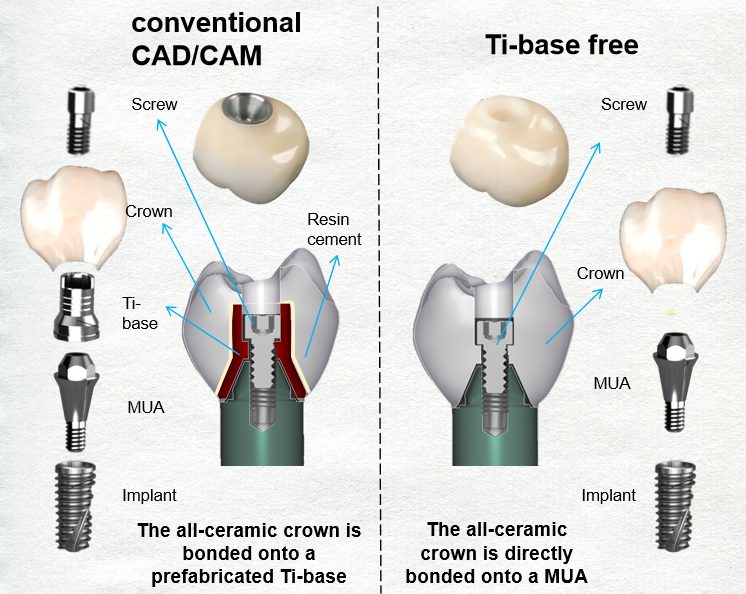
With the development of digital implant dentistry, the concept of ‘base-free’ has gradually emerged in the industry. While maintaining connection accuracy and mechanical stability, this approach optimizes the restorative structure, eliminates unnecessary connection layers, and simplifies the digital workflow.For All-on-X full-arch fixed restorations, there are currently three main retention connection methods between the crown and multi-unit abutments (MUA):
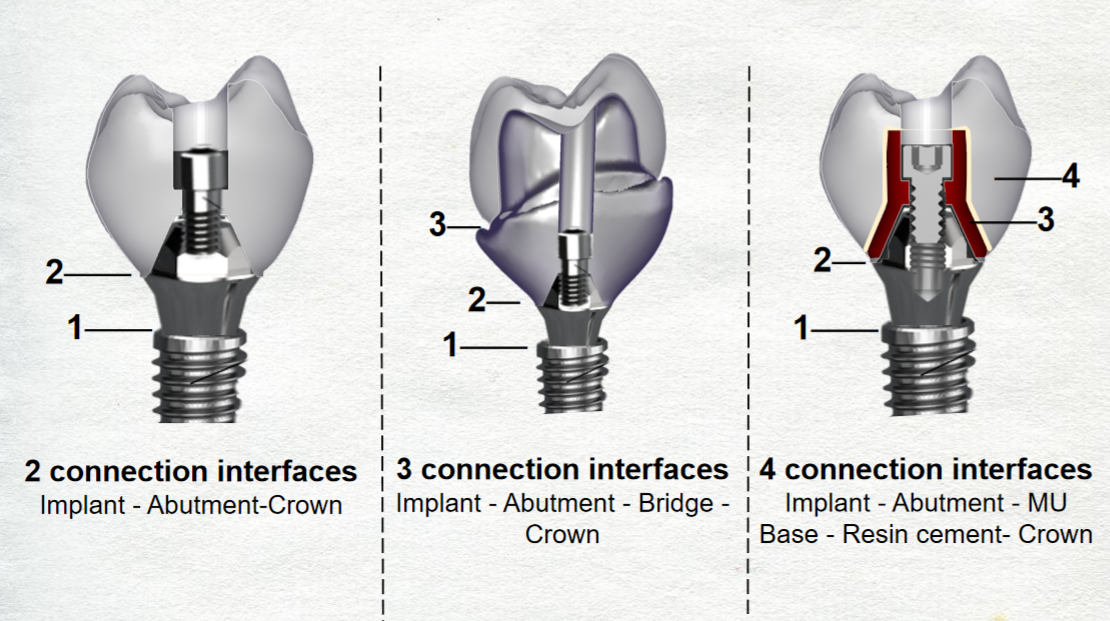
In this section, we will focus on the third approach and discuss the working principle of the MU Base. Essentially, the MU Base functions as a mechanical connection component between the MUA and the upper prosthetic structure, providing precise positioning and stable support for the restoration. Currently, the MU Base has been extensively applied and clinically validated in full-arch digital implant restorations. It has become a widely adopted connection solution in modern All-on-X restorative workflows. The conventional MU Base retention design is composed of 5 individual components, creating 4 separate connection interfaces within the restorative assembly:
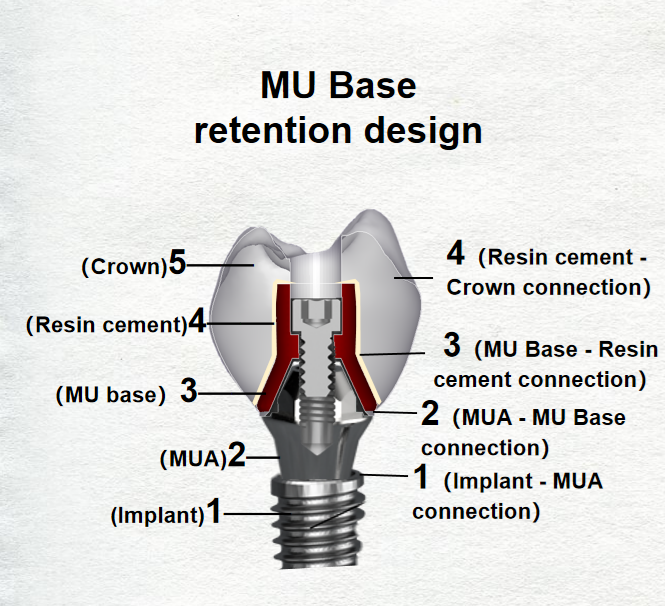
These connection interfaces collectively contribute to the transmission of occlusal forces within the implant-supported prosthetic restoration.The advantage of a multi-component design is that the MU Base, acting as an intermediate component, can provide stress distribution and buffering. Additionally, the all-ceramic crown does not need to directly engage with the abutment.
However, it should be noted that increasing the number of components does not necessarily improve the restoration. Additional connection levels may introduce more components and more complex procedures. The MU Base and crown require bonding with resin cement, which creates potential risks including Debonding of the cement layer and disruption of the cement interface. Moreover, limitations in MU Base height and geometry may affect the emergence profile.In full-arch implant restorations, these factors can lead to increased costs, more bonding procedures, and accumulated discrepancies caused by multiple connection interfaces.
Therefore, modern digital implant restoration is not focused merely on reducing the number of components, but on achieving the optimal balance between component design, connection precision, mechanical stability, and clinical reliability. Ultimately, the success of a restoration is determined not by the number of components within the system, but by the precision and reliability of each individual connection interface.


