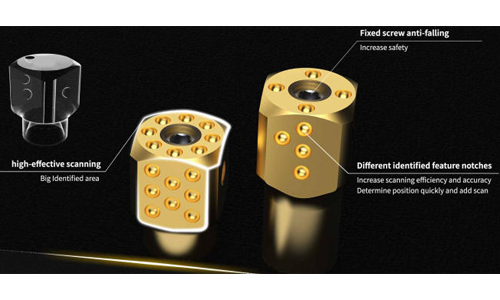
Full-arch implant rehabilitation places the highest demands on digital accuracy. Minor stitching errors during intraoral scanning can translate into clinically significant deviations, affecting passive fit, occlusion, and long-term biomechanics of All-on-X prostheses. The M6 Dental All-on-X Scanning Solution provides a feature-engineered approach to reducing full-arch stitching deviation—offering a prosthetically driven scanning system that integrates seamlessly with full-arch-capable intraoral scanners.
Engineered Multi-Level Feature System for Reliable Implant Localization
The scanning kit applies a structured 3D feature matrix to ensure accurate recognition across varying gingival heights and implant spacing.
Key engineering components include:
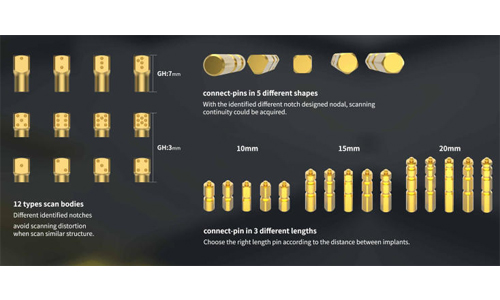
This integrated architecture establishes a unified coordinate system—reducing stitching-node error and offering a functional alternative to photogrammetry in many full-arch cases.
Optimized Surface Engineering for Scan Stability
All scanbodies are manufactured in sand-blasted titanium, producing micro-texture patterns that improve light capture and scanner recognition even under saliva contamination or challenging intraoral reflections.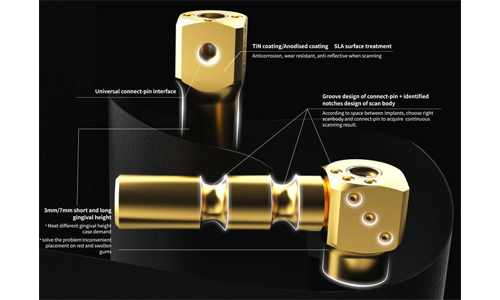
IOS Requirements for Full-Arch Implant Accuracy
To fully leverage the M6 feature system, clinicians should confirm that their intraoral scanner provides:
Clinical Validation & Quality Assurance
Before clinical deployment, clinicians should verify scanner performance using a full-arch model equipped with M6 scan posts. STL datasets should exhibit:
The M6 Dental All-on-X Scanning Solution combines geometric feature engineering with scanner compatibility to deliver a reliable, repeatable full-arch digital workflow. When paired with a full-arch-accurate IOS, the system supports precise implant position capture and high-fidelity prosthesis fabrication—advancing the quality and predictability of All-on-X treatment.