Traditional dental implant procedures rely on doctors' clinical experience, with bone volume assessment errors ranging from 15% to 30%. This leads to significant surgical risks and uncertainties in treatment outcomes. In contrast, AI-assisted implantation does not replace physician decision-making but provides precise data-driven support, effectively reducing errors caused by over-reliance on experience. Today, AI technology is optimizing the entire diagnosis and treatment workflow, achieving millimeter-level precision. Countless dental clinics worldwide have adopted AI extensively, and clinical cases fully validate its core value.
Trained on millions of multi-dimensional dental data points (imaging, clinical records, biomarkers), AI refines the traditional "experience-driven" clinical logic:
Accurate Anatomical Structure Segmentation: Powered by 3D-CNN algorithms, AI automatically segments 22-30 key structures (e.g., dental arch curves, inferior alveolar nerve canals) with a measurement error as low as 0.04mm—50% more efficient than manual segmentation. A joint CBCT auto-segmentation system developed by 15 institutions across China, the U.S., and Europe processes 4,938 complex images, cutting preoperative planning time from 2 hours to 10 minutes. It is now deployed in 23 clinics globally.
Intelligent Risk Prediction: Integrating bone density, medical history, and other data, AI predicts 5-year implant success rates with 95% accuracy, alerting to potential risks 6-12 months in advance. Nobel Biocare’s AI system supports thousands of clinics worldwide, helping boost success rates to 99%. Shanghai Ninth People’s Hospital’s periodontitis AI screening tool achieves 94.2% accuracy, improving success rates for high-risk cases by 27%.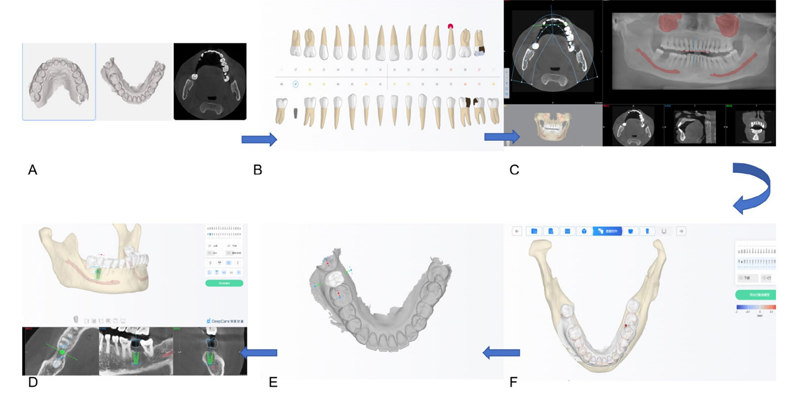
(A) Import CBCT and intraoral scan data;(B) Automatically identify edentulous sites and select implants;(C) 3D reconstruction and segmentation of key structures (e.g., alveolar bone, maxillary sinus);(D) Multi-modal data registration;(E) Virtual crown generation based on restoration requirements;(F) Automatically generate implant positions and related parameters.The entire process achieves an automated closed-loop from data to treatment planning.
Personalized Treatment Design: Using digital twin technology to build 3D oral models, AI simulates over 100,000 implant trajectories to match optimal sizes and angles. Xi’an Jiaotong University School of Stomatology leveraged this technology to complete the world’s first AI-assisted implant for fibula-reconstructed jaws. By 2025, over 50% of implant plans are expected to be AI-personalized.
AI Implant Planning Algorithm Architecture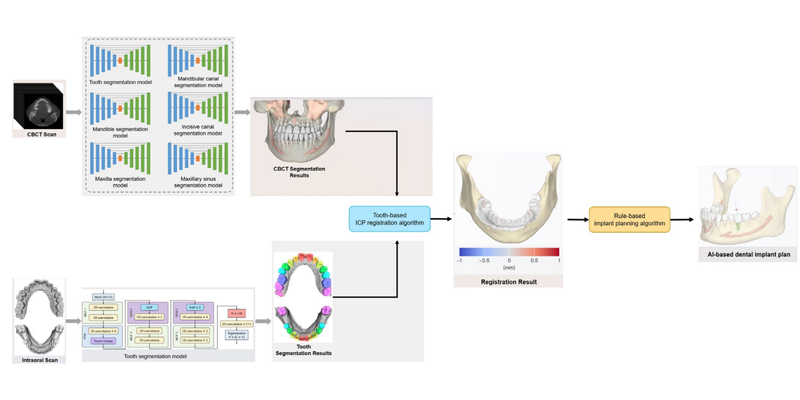
The system's core algorithms include multiple 3D segmentation models (adopting 3D U-Net networks) for accurately segmenting structures such as teeth, jawbone, nerve canals, and maxillary sinuses from CBCT data. Intraoral scan data undergoes tooth position segmentation via Mesh-Seg-Net. Subsequently, the ICP algorithm achieves high-precision registration of CBCT and intraoral scan data, and finally, implant positioning is automatically completed based on rule-based algorithms. This architecture has demonstrated high segmentation accuracy and planning reliability in tests.
AI navigation breaks through the limitations of "blind operation" in traditional surgery, providing real-time technical support for physicians:
Real-Time Path Guidance: AI-generated surgical guides combined with intraoperative CT images calibrate angles in real time. Linyi Zhongda Stomatology used an AI navigation robot developed by the Air Force Medical University to perform full-arch implants on a 72-year-old patient with severe bone atrophy (60% alveolar bone resorption). The procedure was completed in 1.5 hours with an intraoperative error ≤ 0.2mm, shortening recovery time by 60%. Robot-assisted crown deviation is only 0.7±0.3mm—far superior to manual operation.
Intelligent Artifact Removal: CycleGAN algorithms eliminate metal artifacts, increasing the signal-to-noise ratio by 8-12dB and providing clear visualization for intraoperative decision-making.
Dynamic Risk Mitigation: 3M’s AI system monitors intraoperative data in real time, reducing complications by 30% and shortening surgery time by 20%. Sichuan University’s AR+AI navigation system—validated in 53 clinical cases—further improves efficiency by 40%.
AI makes implant outcomes quantifiable and predictable, supporting the construction of a full-cycle management system:
Precise Osseointegration Monitoring: AI analyzes postoperative CT images to assess implant stability, cutting healing evaluation time from 4 weeks to 2 weeks. ShanghaiTech University’s PerioAI system—trained on multi-modal data from 2,500 patients—achieves a digital probing error of only 0.04mm, accurately verifying whether osseointegration meets biomechanical standards.
Intelligent Remote Follow-Up: AI remote monitoring systems track recovery data with 90% accuracy for early warning of abnormalities. Zhongjiayi Stomatology’s "One-Day Dental Implant" program has served over 3,000 patients, enabling "same-day surgery and prosthesis placement" with a 99.2% 5-year survival rate (ITI certified).
Prosthesis Optimization: Based on GAN models, AI-designed prostheses match natural teeth with over 90% morphological similarity, improving occlusal balance by more than 70% while balancing function and aesthetics.
From Novartis’ AI-optimized implants to Fussen Technology’s full-process solutions, AI is becoming physicians’ "precision diagnosis assistant," driving dental implantation toward steady transformation into "precision, personalization, and intelligence." In the future, federated learning and explainable AI (XAI) will gradually address data privacy and trust issues, while the integration of AI with 3D printing and robotics will continue to enable intelligent upgrades to implant surgery.
For clinics, AI is a core competitive advantage to enhance treatment quality and expand service reach. For dentists, it is a powerful tool to reduce workload and overcome clinical limitations. For patients, it means shorter treatment cycles, lower risks, and longer-lasting outcomes. As technology implementation costs decrease, AI will undoubtedly become a standard auxiliary tool in dental implant restoration, bringing the safety and efficiency of precision medicine to more people.


